
Seven cats and two dogs were beyond my help in the states of Texas and Louisiana. Using plastic bags and scraps of paper, sometimes cardboard boxes scavenged from nearby trashcans, I did my best to at least move them out of the road. I don’t really know why I felt so compelled to do so. Maybe because it forced me to acknowledge them, instead of just continuing on down the road like the very cars who had taken their lives. The act of carrying their bodies, many of them still warm, slowly but surely caused me to become used to the experience. I was their pallbearer by default; absent from their lives, yet somehow profoundly impacted by their deaths. Maybe I should have left them where they died, so that others would see them and slow down or drive more carefully. Unfortunately, the ammount of roadkill I saw on a daily basis in the rural South convinced me that most drivers were too entitled to care.
Entitelment is the word that comes to mind because of the numerous degrading experiences I have had as a female cyclist. I have been driven off of the road by several men in trucks, had thick plumes of exhaust deliberately blown in my face by countless men in trucks, and have received immeasurable unwanted attention from men both in and out of their trucks. It isn’t annoying, it is far past that- it is terrifying. If I have to watch one more man in a truck run over the body of a dead cat in the road I am going to explode. It is apparent that many drivers have no problem gambling with the life of a cyclist simply because we have the audacity to share the road with them, so it is not surprising that they seem to have complete disregard for the lives of animals on the road, too. I imagine it is incredibly painful to get hit by a car; and believe me, I have had plenty of time to imagine it. Sadly, I know these drivers are not stopping to check that the animals they hit are not suffering, because they can’t even be bothered to step on their brakes for the few seconds it takes to safely pass a cyclist.
This breaks my heart. I feel so overwhemed by the amount of animal suffering that I have witnessed in the past few months that I am completley exhausted. A recent conversation I had with a man in Alabama as I removed one of the aforementioned cats from the road sums up the type of blatant ignorance that I am referring to when I say “Southern Entitlement.” He wanted to know why I didn’t stop to move all road kill (squirrels, raccoons, armadillos, etc) from the road. I told him there were simply too many. He responded with the same level of stupidity that I encounter when people accuse me of being cruel to vegetables after finding out I am a vegetarian, and said, “Then you aren’t a real animal lover, are you?”
Oh yes, I am a real animal lover, and I am sick of that part of my charachter being used to discredit my rationality. It is not irrational to be kind, and yet I find myself constantly having to justify myself as an activist to much older people who think that being “middle of the road” is the only way to be a realist. What part of being a feminist, animal-loving liberal activist makes me weak? Could it be that all of these qualities challenge the patriarchy?
When it comes to understanding why a certain demographic seems to be at the root of these problems, I find myself constantly trying to avoid stepping on toes. So here’s my obligatory disclaimer; not all men are careless towards animals and creepy to young women, of course I know this! It has been my beleif for a long time that the patriarchy is nearly as detrimental and limiting to men as it is to women. In fact, it is the gentle, kind, and respectful men in my life that cause me to be so concerned with the toxic (and fragile) form of masculinity that is rampant in the South, particularly among far right-wing conservatives. How many of the trucks that drove me off the road were sporting Trump/Pence stickers? 3 out of 4. That seems incredibly relavent to me, so much so that I don’t think I need to moderate my opinions on the subject of male agression and the negative affect it has on the welfare of animals.
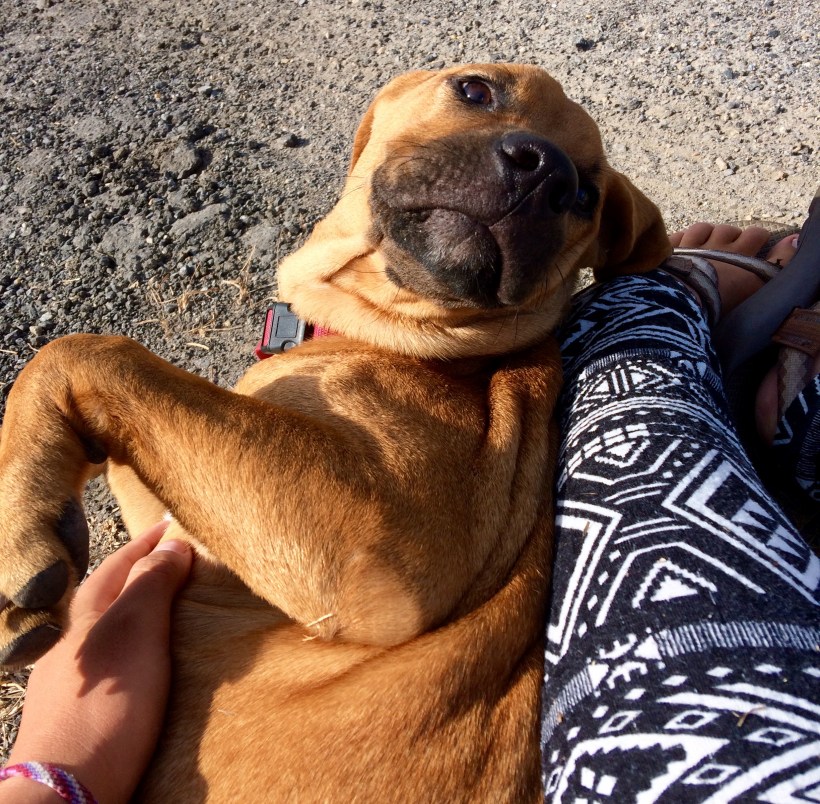
The latest stray puppy that I had the pleasure of rescuing from the middle of nowhere was a tiny brown pitbull named Hazel (see below). She, like many of the rescue dogs I have met in my personal life and on the Southern Tier, was terrified of men. How she developed this fear is only to be guessed at; maybe she was being molded into a fearsome watchdog, or physically abused in any number of ways. Her condition was made worse by the other men in my company when I discovered her, whose suggestions for her welfare involved throwing cookies at her, yelling at her, and slamming the van doors to scare her away. She was growling and appeared to be agressive, especially when the sherrif showed up and tried similar tactics to wrangle her. It wasn’t until they all left, and the women on my cycling team were left alone with her, that she emerged from her hiding place, wagged her tail, and let us rub her belly.
The agressive display of dominance that some men feel obligated to express could have cost this sweet pup her life. The sherriff told me that if he took her to the shelter and she growled, she would be euthanized. Another rescue I called said all pounds in the area were under orders to put down every pitbull they receive. It is evident to me that improper treatment is what causes this particular breed to become agressive in the first place. That was obvious yesterday as I watched Hazel cower in fear under the shelter of our company van.
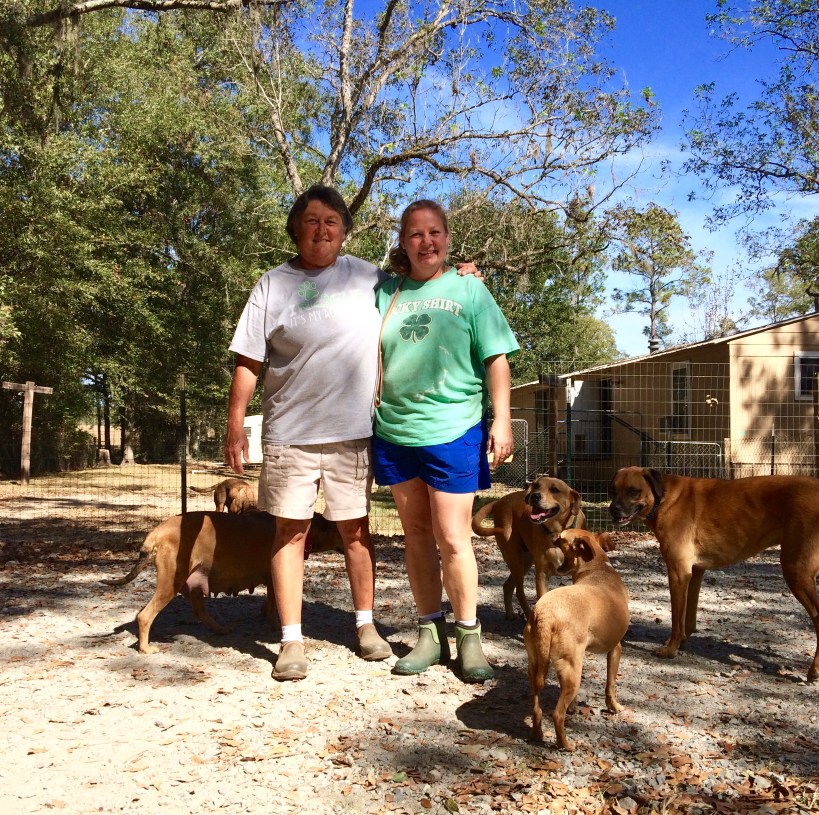
Only by a stroke of luck did I come into contact with an organization called Lucky Puppy Rescue, and that is exactly what Hazel was when I brought her there. Run by two women who care for about fifty dogs out of the kindness of their hearts, I was incredibly releived when they were able to take this puppy in. I could see right away that the dogs in their care were given the treatment they deserved; they roamed freely together in harmony, were well behaved and trained, and hardly barked when I arrived with their new playmate. Almost all of them were rescued strays, and almost half of them were pitbulls. That sounds like a miracle to me.
Below is a picture of the owners of this rescue, Teri and Becky, with a few of their dogs. They are running their rescue solely on donations, so if you are able please help them out, I can’t think of a worthier cause. I have also included a link to their webpage.
I leave this entry on somewhat of a sour note, as I try to remain optimistic about the conditions I have seen in the deep South. I can indeed confirm that chivalry is not dead, but neither is racism, sexism, classism and homophobia. However, a lot of innocent animals are. While this reality is true in every part of the country, this area seems to have an uneven distribution of ignorant and entitled people.
Visit theluckypuppy.org to donate.
 Rove & Ponder