The art of crying in the desert.

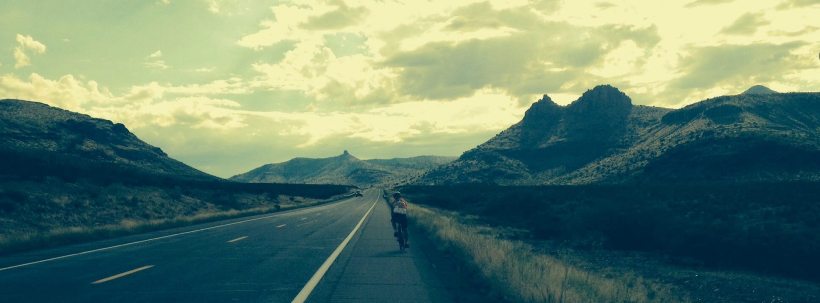
The sunrise the next morning was beautiful. There was enough shallow cloud cover that the sky was cool and pink; a color that would turn to a muted yellow as the day went on. In the desert the sun didn’t have to be beating down on you for the air to be hot and dry; I learned this lesson early, only to have it confirmed on a daily basis when I was going through the Texas hill country. In eastern Arizona, however, this was a new kind of atmosphere.

In my mind rural America has always been that color; the color of the watered down iced tea that the dried out people drank on their yellow doorsteps. The watchers; the ones with the cats with yellow eyes that had a way of following you long after you were out of sight. The people with the yellow fences, and the yellow trucks, and in some cases, the yellow teeth. Their grass, their water, the windows of their houses- they were all yellow. Maybe it was the hazy sky that had this affect on them, or maybe it was the heat. Either way, Tuesday, September 22nd was coated in a fog of deep-southern heaviness that stuck with me for many reasons. It was a momentous day.

I saw my first dead dog that day, an image that has stayed with me as vividly as the day it happened. She was a gray pit bull, and when I came upon her she looked like she was sleeping, or had been alive only moments ago. Maybe the car that hit her had been one that had passed me earlier, and seeing her so carelessly laid to rest made me wonder why it hadn’t been me. Was it just chance, or was it because I was easier to see? Either way, the feelings she evoked were not really anger or frustration, or even fear; it was just regular old heartbreak. She didn’t even have a collar. Not only did I have the overwhelming urge to cry but I felt an overwhelming obligation to it too; this animal deserved to be mourned, and regardless of if anybody else was going to do it, I was.

Crying in the desert was an experience unlike any other, and at this point in my trip I was not yet accustomed to it. It was almost paranormal, the way it snuck up on you and held you down for as long as it wanted, and then disappeared quietly as if it had never happened. There was something about letting myself cry that felt so dangerous, maybe because I felt unusually close to falling apart all the time. I was almost always able to avoid it by being optimistic, which is why it was so rare, but today was one of those exceptions.

It was easy to get caught off guard by certain moments, even the seemingly ordinary ones, because when they mixed with the loneliness of the desert they had a way of becoming extraordinary and momentous. The act of passing by a dog like the ones I was missing so much at home, and realizing that it wasn’t even really a dog anymore but just a body, was a significant moment for me in that way. Sometimes, however, moments became momentous for more obvious reasons; simply because they were traumatic. I experienced another one of those moments several miles up the road.

As I crested the top of a hill I saw a couple of cars pulled off to the side of the road, and beside them, one of my friends, who was laying unconscious on the pavement. She had presumably hit the rumble strip and had detached herself from her bike, which was laying damaged in the dirt. She, too, had been damaged by the accident, and didn’t come to for a solid five minutes. I called the police as one of the other cyclists helped her the best he could, because he was an EMT. She woke up before the ambulance even got there, and she had no idea what had happened. Nobody had seen it. All I knew was that I had been going about 30 miles an hour as I came down the hill, and she could have been going even faster when she crashed.

The way she thanked us all so profusely when she was awake, and the way she climbed onto the stretcher all by herself was an incredible display of strength. She was taken in an ambulance and then airlifted all the way back to Phoenix, where they determined that she had severe traumatic brain injury, five broken ribs, a punctured lung, and numerous other injuries. She didn’t return for the rest of the trip, and wasn’t able to ride her bike again until months later. It was undoubtedly the most unexpected event of the entire trip.

She was such a fast rider, and she had so much more experience than me. Her abrupt absence was so unusual and unexplainable that the Southern Tier bike route itself began to take on a much more hostile demeanor. Nobody knew what to expect, and the rest of the trip was simply different from that point on. We were without one of our strongest riders for one thing, and without the same relaxed view of our safety that we had had before.The day that began with a soft pink glow ended in a cloud of yellow dust, as we finished the rest of an 80 mile day that felt too long not only in distance but in magnitude. After the accident it became evident that I was more than capable of doing the same thing, especially since I was so inexperienced. I was not indestructible; in fact, from that point on I began to feel vulnerable.
The act of moving on.

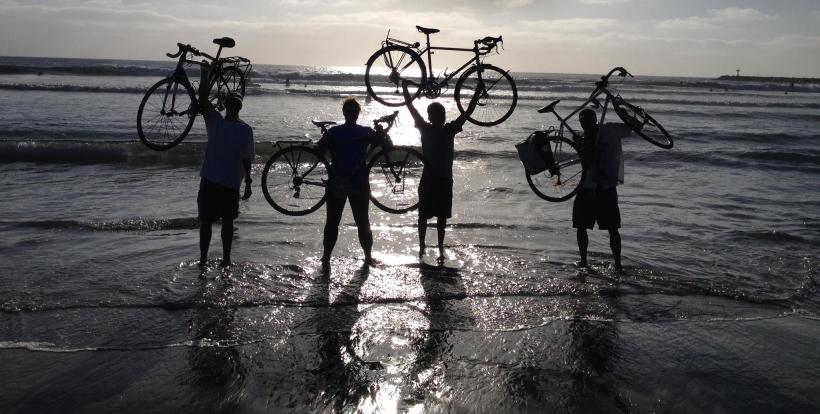
The day I met the Bike the US for MS cyclists was one of my favorite days of the whole trip. They were the most refreshing group of people- some of them were significantly older than I was, and some were my same age. Most of them had more experience than me, but there were a few who didn’t, and that was a big relief to me. To be honest, the fact that I was no longer the only female in my group was one of the biggest selling points. After one day of cycling with them I accepted my new change of plans without a second thought about what I was leaving behind, which was uncharacteristically easy for me to do.

We rode out of Tempe bright and early; the sun was coming up over the cactus-capped mountains, and everybody was feeling optimistic. Those were always the best days; when we were all collectively naïve as to what was in store, and we were able to not only convince ourselves, but each other that it was going to be an easy day. Needless to say those days were never easy; they always turned out to be mega hot vertical inclines with no shoulders and ample big-rig traffic, paired nicely with minimal passing zones and no places to pee. What made them great was how hilariously ironic it was. Also how pissed off everybody was about it, including myself.

Luckily it was easy to find humor in these situations; the false summits and angry truck drivers who didn’t want to share the road; because it was hard not to be happy when I was with such an incredible group of people. Cycling van-supported was just so much better than the first week of my trip. Though I still found ways to completely stress myself out, at least I never had to worry about food, water, and bike repairs. For a little while, anyway.

Unfortunately, one of the things that has always stunted my ability to go with the flow is my restlessness; I have always felt constantly pinched for time in every aspect of my life. This might explain why I felt like I needed to ride my bike across the country as soon as I was old enough to do it without my parent’s permission; it always seems more practical to jump the gun than to wait. This didn’t change on my bike trip; I often felt more anxious when I wasn’t on my bike than when I was on it, I suppose because I was continually anticipating the act of moving on. Because of this I never really let myself look back- if I had no time for rest then I hardly had time for eating, and that was undoubtedly my priority 99% of the time. Even to this day it is sometimes exhausting to reflect on what I left behind in such a rush, maybe that kind of eagerness to escape is rooted in fear also. If nothing else, the fear of never having any of those experiences again seems justified.

Moving on was not only difficult emotionally, but in the literal sense as well. A common occurrence in those early days with the new cyclists was facing the challenge of whether to navigate on my own or try to keep up with the rest of the group. I was usually pretty confident that I was capable of finding my own way, but it was more than just a hassle, it sometimes meant the difference between having a helping hand to change a flat tire with, or being completely on my own. The difference between having to outrun a whole pack of watch dogs, or just having to outrun my fellow cyclists. The difference between being able to zone out and stare at the rear tire of the bike in front of me, or actually having to pay attention to keep from going off the road. There were pros and cons to both, especially since trying to match somebody else’s pace could be exhausting regardless of if they were faster than me or slower. It was kind of like choosing the lesser of two evils.

For everybody else, moving on didn’t seem to be so much of an issue in the sense that they didn’t have to mentally prepare for it. Everything would be moving at such a slow, manageable pace until suddenly it seemed that everyone would run out of patience at once. I guess by the end of the trip I started to get this way too; just another way we cyclists can be overachievers. But the difficult part was the fact that this sudden urge to get up and get moving was just that- sudden.

When the time to be leisurely abruptly ended the act of cycling could kind of become a race, and that was something that stressed me out to no end. Some balance in the world would be ever so slightly off and before we knew what hit us even the slow riders would be pushing to maintain 20 miles per hour, into the wind or with it, it didn’t matter. I would be one of them, drafting as much as I could and struggling to shake off the early morning fatigue as fast as I could.

I never regretted it once I forced myself to get going; in the desert it made a lot of sense to get on the road as early as possible, because the mornings were always so much cooler than the evenings. There was also a lot less traffic, which always seemed to brighten everyone’s mood. I think my favorite thing about those early morning rides was how satisfying it was to break the stillness. When the world was at its quietest, it’s gentlest; we were at our most lively. We were on a mission to breathe in the coolest, freshest air of the day while there was a never ending supply of it. While the earth was still catching up to us, we were already prepared for the day. That was the best part about the mornings; the fact that they were so unblemished, and so promising.

The dawn can be like that a lot; almost everything I do starts off really well, which might explain why my intuition doesn’t tell me to give things a second thought. Luckily the rest of my trip was generally incredible, so that first day was a good example of what I could expect for the next 2,500 miles. There were still some tough times though, of course there were, and the next day was one of them. We were moving along just fine, and then everything changed when one of us got hurt.

One of the few times that feeling sorry for myself was actually an appropriate response.

After my abandonment in the urban heart of Arizona, there was one particularly profound fact that I couldn’t stop thinking about: A phoenix rises from the dead. It is probably melodramatic for me to say that my initial failure was essentially death to me at the time, but the prospect of moving on did seem like rising from the ashes in some sense. Whether that was the ashes of my recently deceased youthful idealism or the literal flakes of my sunburnt skin, I was in no condition to be optimistic anymore. My time had come to feel sorry for myself.

I was embarrassed, and I didn’t know how I was going to tell my family and friends. I also felt stupid and incapable, and being the only girl in my group had even caused me to blame my gender for some of my shortcomings. And my age, and my maturity, or lack thereof. I felt like everything that had happened had been the fault of my naivety, and I was frankly pissed off that the real world was turning out to be so anticlimactic. I was in the process of learning the hard way, and it seemed like nobody was willing to give me any patience.

That is, of course, until I met up with Bike the US for MS. I called my mom moments after my group left me, in a McDonald’s bathroom as I sobbed over an M&M McFlurry that I thought would make me feel better. Not long after I hung up the phone she did a good old-fashioned google search and quickly found me a new group to bike with. They were van supported, raising money for Multiple Sclerosis, and they were going to be coming through Phoenix in a week and a half. That meant that I had ten days to get my shit together.

I started by making a list of all the reasons I had been abandoned, because I couldn’t accept that I had been totally ignorant. On the contrary; I have almost always been able to trust my intuition, and I swear to god those guys didn’t give me one hint that they were going to give up on me that afternoon. So the first thing I put on the list was the first thing they had told me- that I had bought the wrong bike. Now that I was going to be riding van supported I wouldn’t have to carry all of my own gear, so that was no longer an issue. Then I wrote down the other, more personal things they told me; that I was too inexperienced, too young, and too much of a cause of guilt because they felt personally responsible for my safety, thanks once again to the fact that I am a girl.

It seemed like there was nothing I could do to change any of those things, so I spent the next ten days bracing myself to fail once again. The only thing I had going for me was the fact that my bike was going to be 65 pounds lighter than it was, but I was also facing the prospect of riding a lot farther than I was used to. The van supported group rode an average of 70 miles a day, which was more than a cause for concern for me. I still had 2,500 miles left to go, and I was going into it with a severe lack of excitement and incentive. I would no longer be able to say I had biked the Southern Tier self supported; I would no longer be able to raise money for WWF like I had planned. I felt like my only reason to continue was to prove that I could do it, and that didn’t feel like an admirable reason at all, it felt selfish.

Luckily I had no other choice, or else I might have chosen to continue on all by myself. I don’t know if it was fate that landed me with Bike the US for MS, but after only one day of riding with them I felt like a weight had been lifted off of me that was much heavier than 65 pounds.

How the first week of my trip became infamously terrible.

I spent a significant part of last summer preparing myself to get knocked on my ass, because I knew that I was not going to become a cyclist overnight. When the reality of what I really wanted sunk in, and I accepted the fact that I secretly craved hardship, I suppose I started trying to seek it out. I always knew that in the end, my efforts would not be wasted; I didn’t have to go very far to find it.

As a teenager on the quest for enlightenment it has always been easy to elaborate on the dark side of life. It has always been easy to get lost in carefully chosen words, or lost in the pages of a seldom used moleskin journal. I didn’t know what I was doing, and I guess in many ways I still don’t. I hadn’t been cycling for long and I hadn’t been writing for much longer. All I knew was that I wanted something from a particular piece of time, something that I did not intend to return. And I thought the only way I could capture that was through writing.

Getting lost in the daily motion of constant pedaling was just another way for me to stay in the moment, something that I not only highly valued but also found to be really tricky. The loneliness that I had been striving for kicked in as soon as I realized that I was doing something that most people didn’t even want to do. I was doing something that was going to be a lot harder than I expected, and I was going to be doing it by myself. So began the most difficult part of my bike trip- the summer leading up to it.

I thoroughly hated every minute of my daily bike rides at first, mostly because they were so repetitive. There is something surreal about moving through space at a steady 14 miles an hour, but for some reason I spent most of my summer taking full advantage of the ability it gave me to zone out. I used this same trick a lot when I was on the Southern Tier; when I wasn’t looking out at the emptiness before me, or squinting my eyes to catch a glimpse of the Atlantic coast, I was staring down at my front wheel and day dreaming.

What I was dreaming about last summer was making my escape. How was riding my bike across the country going to be beneficial to me? Mostly I just didn’t want to go to college; it wasn’t even Autumn yet and I was already terrified of getting caught in the cycle of post-highschool normality.

I have felt this self created pressure to swim upstream more and more as I have gotten older. As long as I have been encouraged to blaze my own trail, I have assumed that I have been doing the right thing by purposely being an outlier. I don’t know where my generation got this ability to follow our dreams without having to acknowledge their inevitable repercussions, but we’re lucky we do. The only thing that makes me different from everybody else is only the degree to which I enjoy the eventual downfall of my elaborate plans, because it is dramatic and, in it’s own way, weirdly exciting. I have chosen not to avoid intensity, partly because I like to learn the hard way and partly because it gives me something to write about.

The first week of my trip was intense as hell. The prospect of a 4,000 foot climb in elevation coupled with the fact that it was almost always over 100 degrees seemed daunting enough. What made it shittier yet was the fact that I got food poisoning in the middle of nowhere with three guys that were, at the time, mere acquaintances. By day five my cheap bike was already starting to fall apart under all the weight of my gear, I had changed upwards of a dozen flat tires, I had gotten poison ivy all over my body and I was holding the rest of my group back. Just before we got into Phoenix we were sidetracked by flash flooding and when we finally did get into town, I was left in a McDonald’s parking lot while the rest of my group went on without me.

Looking back it was one of the unluckiest and most uncomfortable weeks of my life, but that didn’t mean that I didn’t love every minute of it. It was so humid that our bodies were constantly dripping with sweat, our eyes constantly stinging from the salt. We used umbrellas as shade at some point; I hid from the sun under a conservative campaign sign that I had felt no guilt in plucking from the parched ground. It was crazy; the desert swallowed the road, and the never-ending road swallowed our motivation. The fire ants taunted us when we thought about sitting on the ground, and when we were thirsty all we had to drink was the hot water we were hauling in our panniers. The smell of the baking earth swarmed in on us and took our minds on some tired, hallucinogenic trip. We were lost, but we were together. At least until I got abandoned.

I had essentially failed because I hadn’t given up on myself, and therefore my cycling companions had to give up on me. I can’t say that I enjoyed being tired, hot, or hungry, but for whatever reason I felt prepared for it in those days. Because it wasn’t about overcoming all of the physical limitations that came my way, it was about learning how to navigate through the emotional complications that I expected. For that one week of my trip I was blessed with blissful naivety, and I didn’t realize what I was truly up against. When I was left in Phoenix I felt like I must have been fooling myself, because I had no idea that I was slowing the group down so much. I stayed in the city for ten days before I found a new group to ride with, all of which I spent laying in bed feeling sorry for myself. My bike was falling apart, and I knew that I could fix it, but my determination was falling apart too, and hiding under the covers in an air-conditioned hotel room was not putting it back together.