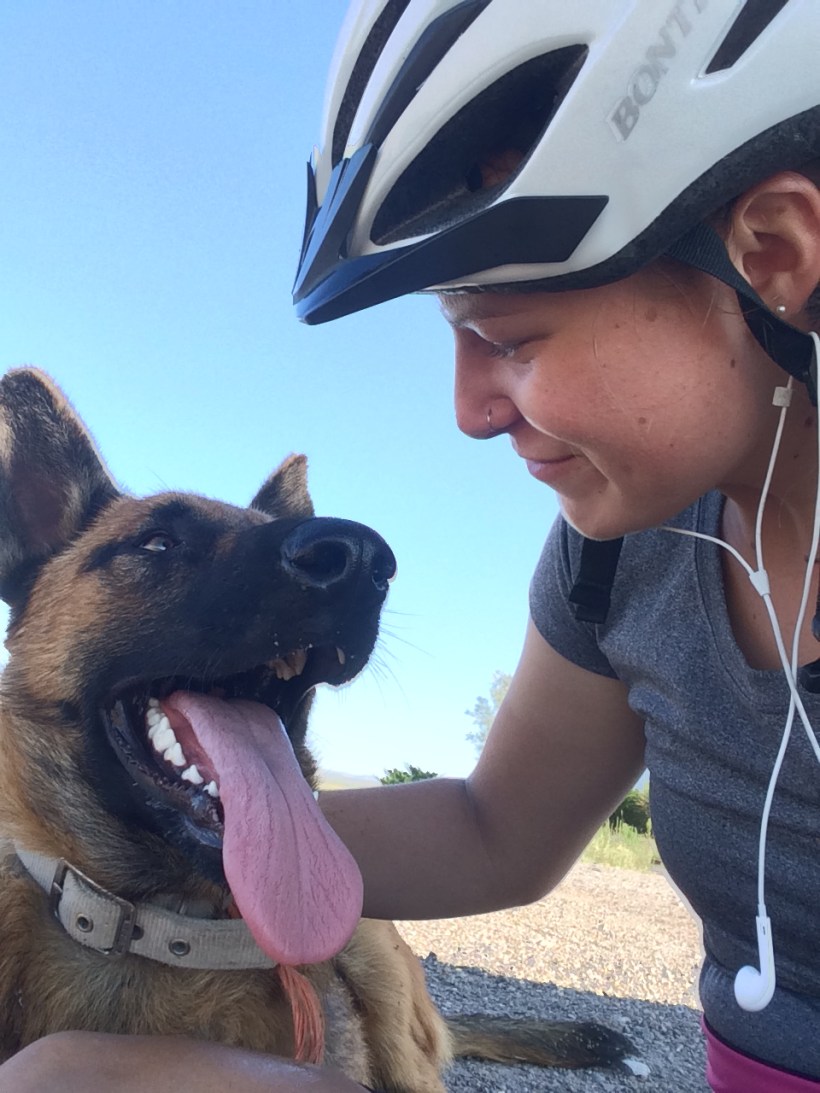
Rescuing Jack: The pup who redefined carelessness.

Carefree; the state of being free from anxiety or responsibility, one of my favorite words. As I grow older its meaning seems to become less and less relevant to my life, but I am eternally craving the feeling. I have always associated it with being calm and optimistic, never careless, never oblivious. Last Thursday, however, I learned that even being carefree comes with a price.

As usual, the morning was cool and refreshing. An electric midnight storm had left a puddle of water around my tent, but under my covers I had stayed warm and dry. I love night’s like that; when I don’t have anything to worry about, at least nothing besides my own comfort. I have learned time and time again just how fleeting they can be, and yet I always seem to take them for granted. This one, however, I savored; all I had on my agenda for the day was a mild, secluded bike ride. As soon as the sun rose to burn all of the moisture away, the atmosphere became immediately hot, as it does every day in the desert. It was around 10am when I met the animal that would take away my peace of mind for many nights to come.

He was just another homeless dog; a swift silhouette on the horizon, prancing the abandoned roads in search of something to eat. Down here, trash is not hard to come by, and maybe that’s why he wasn’t emaciated. I got off of my bike, all too aware that if I flew by him I would be a perfect target to chase, and started speaking in a soothing voice, not wanting to inspire an attack. I know this fear is just extra weight that I carry with me for no reason at all, but I’ve always been especially cautious around these types of animals.

Most Southern Tier cycling websites suggest riders have pepper spray at the ready, because many of the dogs in the South are raised solely as watch dogs. I don’t do that because I can’t imagine ever bringing myself to actually use it, so maybe that’s why I am always on edge. Anyway, it goes without saying that this dog was different. He was shy, but he was irresistably sweet. This pup was so tired that when I so much as gave him the acknowledgement that he had gone without for so long, he immediately fell into a deep sleep beside me, exausted fom god knows what he was doing.

Dozens of flies swarmed the cuts on his face, as fire ants went about building a nest only a few feet from us. He didn’t stir. After drinking the rest of my water, I think he finally felt comfortable enough to rest. With his head on my knee, we waited under the shade of a billboard for hours while animal control drove out to us.

I feel like calling animal control was my biggest mistake. This sweet animal had done nothing but kiss me, and trust me, and wag his tail at me. Still, when the officers came to put him in their truck, they were not gentle. I can only imagine how scared he must have been in that dark metal box that they put him in, and for good reason. So many abandoned animals take their last rides in that truck, before they spend their final days in empty cages. That is exactly where this dog was headed, and I knew that. The next day, when I went to the shelter to “bail him out”, I saw for myself just how bleak this particular shelter was.

I spent the next 24 hours conflicted with the idea of trusting the animal shelter that he had been taken to, or taking matters into my own hands. Several calls to the shelter helped me make my mind up pretty fast, as they could not assure me that he wouldn’t be euthanized after his 48 hour grace period was up. Las Cruces, New Mexico is so overwhelmed with stray dogs that only the cream of the crop stand a chance of being adopted. The ones that can’t be taken in are unspoken of, and disposed of.

I’ve been to kill shelters before, and they are always terrifying. Rows and rows of man’s best freind, all organized by breed and temperment, barking and howling their unheard negotiations for freedom. Each snatched from a world that did not value them, only to be taken to an institution that does not have room for them. At least half of them are pure breeds, whose parents were not spayed and neutered and whose owners were not able to care for them. One might blame this problem on poverty, but I blame it on ignorance.

There are too many dogs in this world, and too many carefree people. Puppy mills, pet stores, and even your average neighborhood backyard-breeders all contribute to a system that leaves hundreds of thousands of dogs homeless, mistreated, and ultimately sentanced to death. Those who call themselves animal lovers should have no tolerence for the breeding industry whatsoever. If the suffering of companion animals is to end we can no longer respond to the ignorance of our friends with a smile and a nod, as I have done for far too long.

In the end, I did find the silver lining in this hellstorm of a situation. Jack, the name given to this sweet dog by his new owners, eventually found his American dream. It wasn’t easy, and the hardest part by far was finding a few kind hearted people who were willing to advocate for my cause. Those people were not the officers who responded to my call, nor the workers at the shelter who only gave me a several hour window to drive him out of state, but the handful of strangers who offered to give me a ride when I did not have a car. The woman who helped me keep Jack from being attacked by another pack of stray dogs, and my always proactive mother who has a way of making anything possible. The last to help me were the real heroes of this saga; Jenny, whose name always seems to come up in my blog posts because she is always willing to go out of her way to do something kind for someone else, and my aunts Jean and Carrie, who are finally giving Jack the secure, forever home that he deserves.

Jack’s story is one that I’ll never forget; it’s exciting, it’s true, it has a happy ending. It’s the story of a puppy who escaped unknown horrors and still managed to be sweet enough to make it into a loving home. His is also a story of privilage, and it’s the story of a really messed up animal welfare system. I can’t stop thinking about what a miracle it is that this one got a second chance, and how lucky he is that he was born a german shepherd, and not a pit bull. It brings me so much happiness to know that he is safe and taken care of, but even that knowledge is not enough to make me feel optimistic. The truth is, I am heartbroken. This experience has exposed the truth of the overwhelming amount of animal neglect that this country enables. I wish I could sugar coat this, I wish I could serve the reality of this problem to you under a blanket of encouragement and hope, but I can’t. I can only add this to the extensive list of reasons it feels like America has forgotten the South.

I still battle with the image of all the other animals I left behind; the ones who weren’t desirable, the ones who will never be adopted. The ones who will spend their final days on a bed of concrete, and whose lives are of so little significance that they will soon be forgotten. This is the kind of thing that haunts me, the kind of thing that leaves me feeling hopeless. We saved one; that matters. It matters, but it’s not nearly enough.

I’m a softie, it’s true, and I’m sure I love dogs a little bit more than most. The ones that I have had in my life have brought me out of some of my darkest places, and I will never pass up an opportunity to help bring them out of theirs. The puppy that I lost over a year ago still makes appearences in my dreams, her absense still puts a knot in my throat when I return home, and the memory of her final days will still pull at my heart strings until the end of time. I don’t think any of that is too weird or too extreme. I don’t want people to think that my reaction to finding this stray dog in the desert is too weird or extreme either; it shouldn’t be a big deal, it should be normal.

Adventures like this bike trip sometimes make me feel like I am barreling through space at lightning speed; I just keep going and going and I never want to stop. I’ve seen adventure affect many people the same way, and I don’t think it’s necessarily a good thing. Even after everything I have just said, I have yet to admit that it was actually hard for me to stop for this helpless dog. Knowing how many homeless dogs there were around me, I was ready to cast him off as “just another one.” I’m so glad I didn’t. I’m so glad I stepped on the brakes for what amounts to the blink of an eye in my life, because it had a profound effect on the rest of his. I’ve just breached Texas, and I can only imagine how many more stray animals I am bound to come across. I can only dream that the ones I stop for will be able to live the carefree life that Jack gets to.


Veritas- a cooler word for the truth.

I never thought I’d return to the Southern Tier as a route leader; I thought my days of soul searching and daydreaming under the desert sun were over. When I got offered the chance to return to Bike the US for MS and ride across the country a second time, I laughed out loud. It was like a writer’s miracle; I finally had the chance to go back to all those infamous desert roads and rediscover what I had dubbed as my glory days. In a moment the world felt small again; I had been so sure that 2014 was my once in a lifetime opportunity to prove myself that I actually believed I had absorbed everything from the experience that I could. It goes without saying that I was wrong. Since that time I have learned over and over again that I could never possibly be done growing and each experience I have had has dwarfed the previous one. Now, as I sit a day’s ride outside of Phoenix (the same place I was abandoned two years ago) I realize that I have been looking for enlightenment in all the wrong places. To be honest, I don’t feel like I want to get all introspective and philisophical this time around. In fact, ironically enough I feel like I’ve gotten all of the roving and pondering out of my system for the time being. I’m happy to announce that this blog is no longer devoted to dramatic narratives of self-discovery, thank the lord. This time around, I’m writing the truth.

 
I passed a 200 acre feed lot the other day and it was absolutely horrendous. I was right outside of Brawley, California, so I can officially confirm that happy cows do not come from CA. I’m used to feedlots; I live in the Midwest and take a lot of road trips; but this one was the worst. It included the usual herds of oversized cattle confined to pastures full of two-foot-thick sludge, but it was also no less than 110 degrees out. That is torture for any living animal, and I don’t have to go into how intelligent and social cows are because I covered that in my last post. This particular feed lot was also connected to a slaughter house, and the sounds of cattle bolts and distressed cows could be heard all the way from the road. Hundreds of solar panels stood amoung them and provided the small shelters that the poor animals huddled under, exhausted and afraid, unaware that giant manmade eco-freindly machines were providing their shade. Once again, the irony was unbearable, but not as unbearable as that hot Mojave sun. No one could deny that a sight like this is terrible, and that the treatment of those animals is plain wrong. And yet, time and time again, we somehow manage to. We all do, even if we are only doing so by simply refusing to acknowedge the problem.

 
Maybe in a case like that, humans are too far removed from the problem to take action. After all, I don’t even remember noticing this feed lot the first time I rode by, and that’s probably because I was too preoccupied with my own stresses for the day. I think that too often people like me hesitate to even accept that such things are wrong, maybe because they feel insecure about not being able to stop it or maybe because they feel insecure about contributing to the very industry. Either way, a group of hungry cyclists facing a 90+ mile day are not the ideal candidates for proactive passerby. Of all the pictures posted on social media that day none were of the obviously depressing feed lot, and I’m sure those disturbing images were not even called to mind at dinner time when we stopped at a burger joint. Of course I don’t blame any of them. I do, however, blame the dangerous way of thinking that forces us to justify something that is so obviously wrong just so we can go about our days without having to carry the extra weight of acknowledging it.

 
Unfortunately, on the Southern Tier bike route it is virtually impossible to turn away from all of the abused and neglected animals, and many of them are not nearly as far out of reach. The evening before we got to Brawley we were camping in another small country town called Live Oak Springs. I was on the phone with Jenny when I found I was being followed by two skinny, mangy calico kittens and the first thing I said to her was, “Oh shit, now I have to deal with these kittens.”

 
It isn’t easy to drop everything and devote yourself to taking an animal to a shelter or finding their rightful owner, at least most of the time. Being raised by my kind hearted mother I have always prioritized the health and safety of animals, I think it’s just something that runs in my blood. Even so, I still only take action when I’m not able to justify not taking action. Only when I am sure nobody else is going to do something, especially on a bike trip where I am tired and emotionally drained, do I go out of my way to try and do something. I’m not proud of this, but because I rarely am convinced that other people are going to step in to help a neglected animal I find myself taking that role more often than not. If I had a car I’d save twice as many animals, but with only a bike I am usually reduced to harassing as many local people as it takes to get the job done.

 
In this particular case all I had to do was knock on the doors of a few camper trailers before I found the owners, and then I returned the kittens and suggested they be taken to a vet. In other instances, I have called the local sherrif and closest humane societys, trying to convince someone else to go out of their way to save an animal. I am delighted when I come into contact with a fellow animal lover who is more than willing to help me, but more often than not I spend a lot of time trying to convince people to make a call, or take a drive, or even refer me to somebody else. Everyone is just so busy, that without prioritizing animal welfare I don’t know how local law enforcement can even make a dent in the reports of animal abuse that they must receive. Especially in states like New Mexico and Texas where animal protection laws are virtually nonexistent.

 
The sheer amount of stray animals in the United States alone is overwhelming. The least I can do, besides try my best to help the few individual animals that I come across, is be honest about what I see. It is really the least anyone can do, but even that seems to make a differnce. Americans need to stop relying on the code of politeness and start intervening when we hear our aquaintences joke about blatant cruelty, and especially when we see it in action. If we can stop desensitizing ourselves to animal cruelty, and speak our minds when we come across something that is wrong, maybe animal abuse will finally go out of fashion.

 
Veritas means truth in Latin, and while that is a pretty fancy term to describe the theme of this entry, it felt pretty fitting. One of my fellow cyclists has it tattooed on his arm, and he explained to me today that he got it when he decided to live more truthfully and authentically. I won’t try to recreate his words, but what he told me inspired me to look up the word and I discovered that it comes from the name of an elusive greek goddess who embodied humility and truth. I guess she is my inspiration for the next few weeks that I will spend in the deep South, and as I pass through each town I’m going to document the treatment of animals that I witness exactly as I see it. In my quest to live a kinder and less destructive life I have fallen in and out of denial many times; once before I stopped eating meat, again before I spent time living on a dairy farm, and most recently when I witnessed the giant feedlot in Brawley that never made it onto a postcard. I can’t promise that my clumsy ranting won’t cause me to step on any toes, but don’t let that keep you from staying tuned for my next story! There is a fire lit beneathe me and I have never been more ready to speak the truth.


This is Calico, a highly creative name I gave to the healtier of the two cats. She was a stunner. For a less adorabe picture google Brawley feedlot.


image


Rejection: The unsurprising reality of being a teenage writer

When I was 13 I decided I wanted to write a novel, and over the course of a few years I did just that. At the time I was sure that the mere ambition I had to do such a thing made me extraordinary, and I expected my book would be made into a movie someday. I guess you could say I was an idealist… Needless to say, I was not nearly as special as I thought I was, and my ambitions were far from unique. As like any creative adolescent with a wild imagination, I just wanted my art to get the credit that I thought it deserved. Disappointment was almost inevitable.

Four years later I finished my first book, tried unsuccessfully to publish it, and subsequently began to let go of the dream that had consumed me for most of my youth. Countless rejections to brief queries and pieces of my manuscript left me feeling embarrassed and inadequate. When I was able to accept that my book wasn’t going to be the next best seller, I realized I was further from my dreams than I had ever imagined.

At a time in our lives when optimism and high aspirations seem to be at their peak, why is it that so many of us feel pressed for time? I don’t know about everyone else, but ever since I turned eighteen I have felt as though time has begun to pass faster than ever, and being told that I am in the prime of my life stresses me out more than anything. I am compelled to do as much as I can, as fast as I can. I don’t know if this makes me wise or naive… either way, the feeling certainly doesn’t seem to be fading.

At the same time, life has also never felt more ironic. Now, at nineteen, I have officially entered the realm of adulthood that prevents me from using my youthfulness to my advantage. Instead, it seems to be only a sign of my lack of experience. Any chance that I might have had to use my age as an asset is gone, and I have found myself without a platform or an edge. For writers, and especially writers who don’t know what the hell they’re doing, this is the worst possible position to be in. And yet here I am, just as devoted to my current project as I was my last. I have been working on Into the Wind, a memoir about my struggle with depression before and after my bike trip, since I returned home last November.

While my adventures in querying agents this time around have been much more encouraging, I still haven’t gotten close enough to finding representation to converse with any actual people on the phone. The little interest that I have gotten has kept me on the edge of my seat, and I have even prioritized prospective agents over people in my own life at times. The truth is that I have become, as much as I hate to admit it, madly and undeniably desperate for success. And I don’t think I am alone.

While not all young people want the same things that I do, I know that many of my peers feel a similar pressure to not only be successful, but to be young and successful. Most of us want to change the world, too, which I think is a really good thing for society, but sometimes a frustratingly difficult thing for us to achieve. At times my entire career as a writer can seem to hang on small bits of encouragement that I receive, even though those words are dwarfed by the numerous rejections that I find in my inbox every week. Being so restless by nature and eternally undecided I count on the advice from others to give me direction. When that advice is to follow my dreams and never give up, I can make myself feel powerful and unstoppable. However, when that advice is to be sensible and major in something that will undoubtedly make me financially independent, changing courses can seem tempting, too.

Could my real weakness be the fact that I am so impressionable?

In my plight to scavenge for anything in my repertoire that can make me stand out from the crowd, I have taken the words of one of my favorite writers very seriously. Lena Dunham is the perfect example of a writer who knows how to find beauty in her imperfections, and that is truly what makes her writing so appealing. By being slightly unpolished and painstakingly truthful I have told myself that I shouldn’t force beauty out of my writing, but try to let it come out on its own. This has to be my philosophy, because if I believed that all of my writing had to be literary gold as soon as it hit the paper, I would be totally screwed.

Right now I don’t feel like I could let myself give up if I wanted to, but that doesn’t mean I’m not scared of the repercussions. Opening up has been such a freeing thing for me in so many ways, and equally binding. I can only hope that I become a better writer as I grow older, but I know that when that happens I will have to be careful not to pick apart old writing that I have shared. After all, if there’s anything I know for sure it’s that you have to start somewhere, and I have never been one to wait for the perfect timing.

Sharing things like this reduces so many insecurities that I have about the choices I make. I have used writing to dwell on my insufficiencies and ruminate over my regrets, but I have also used it to dilute my sadness and anxiety by opening up the area in which I keep it. Sometimes being publicly honest is the best remedy for pain and dissonance, and I have even felt relief in just reading other people’s version of the truth. I suppose my ultimate dream in publishing a memoir would be to affect people in a similar way; to free them of the pressure to conform parts of themselves that have yet seemed unjustified.

The Heaviness of Being Home-Free

November 4th, 2014; 50 miles from the coast:

I’ve spent almost sixty days looking for this final horizon; this is where I have envisioned my success. I will plow through the unblemished sand and be met by the incoming tide of the Atlantic ocean, where all of the saltiness of my being will be washed away by the saltiness of the water, and I will be a different person. A better person. Brand new.
Suddenly I feel heavy again. Up until now all of the weight that I have been shedding in the past two months has seemed to be lifted from my shoulders, and even as I hunch over the handlebars of my bike I feel taller, and slimmer. But the heaviness has crept up on me again, and every forward motion feels like I am already pedaling through that promised land sand. Because I don’t want to go home again. I haven’t found enlightenment yet.

By the time I got to Mississippi all I could think about was Florida. As I drew evermore eastward, transitioning through Alabama and landing in the gulf coast, I became consumed by the idea of it. If I squinted my eyes I could see the ocean cresting the horizon, and if I breathed deeply enough I could taste the Atlantic air. I thought about it to the point that I didn’t even pay much attention to where I was, until suddenly I was there. The foam of the St. Augustine sea was splashing through the spokes of my tires and the foam of much awaited champaign was splashing against my skin. In a moment, it was all over.

When I left on my trip a year ago today, I set off in the hopes of broadening my horizons. Little did I know that I was actually, literally just making them smaller. With the help of a couple different bikes I crushed the United States down to a size that had somehow been manageable to me, and with a moderate amount of physical strain I pedaled across it. America was tiny; but the kind of tiny that makes you feel tiny, too, not bigger in comparison. As I approached my final destination I finally began to feel like I was prepared for it; not for the end of my journey, but for the beginning of it.

Unfortunately, making it to the finish line only meant that I would soon be returning home to the short winter days of South Dakota, where my stark tan lines would quickly fade and so would the sense of achievement that I had gained. The let down that followed lasted a lot longer than I expected, and as I’ve said before, I didn’t feel particularly enlightened in any sense of the word. I don’t know why I wanted it so badly to begin with; almost more than daily enjoyment, I wanted growth. But when my trip was over, the greatest feeling that I had toward it was that I was glad I had done it, and I wanted to do it again. I didn’t realize exactly why I was feeling that way until recently.

On the first day of my trip I made a journal entry about the Pacific ocean. I made some melodramatic metaphor about how the sea and I were similar, because we felt so strong but we were ultimately contained within ourselves; we were stuck. As I began to move through space I realized that wasn’t necessarily true for me anymore; in reality, I was as free as anybody could possibly be. I was graced with the lightness of the unknown, something that I have since come to value most about my experience. Looking back, I realize that I was closer to enlightenment on day one than on any other day of my trip, because I was brand new. I had nearly nothing to lose and that, matched with the exhilaration of not knowing what the hell I was doing, is the closest I have ever come to complete freedom.

When I finished something that was so pivotal in my transition to adulthood, I found it impossible to move on. The only way it stayed with me was if I continued to drag it around long after it was over. Though the memory of my experience on the Southern Tier is heavy with longing and nostalgia, I would never dream of letting go of it. Instead, I continue to reflect on it, motivated by my eternal desperation to write it all down. The only way I see that changing is if I replace it with a new, bigger adventure. But being a broke college student, that is easier said than done, and I spend more time than I would like to admit just fantasizing about what I might do next.

It is that anticipation that makes everything I do seem less risky, like settling down and going to school, because I know that there must be something in my future that will give me that same feeling of freedom again, and purpose. Even though I didn’t realize it at the time, I was so lucky to have an adventure that was so rich in new experiences, hard lessons, and satisfying rewards. But those aren’t always the best stories to tell, and I feel compelled to find another story to write about, one that has to do with much more than just myself. Next time I set off for the great unknown (which will be as soon as I possibly can) I’m going to focus less on the destination, and more on the journey.

Louisiana

Though the first 2,000 miles of our trip encompassed twice as much space as the last 1,000 miles would, we were soon to find out that it was somehow less diverse. Because this land was otherworldly, I knew it from the second I read the words “Bienvenue en Louisiane.” I knew I had officially arrived at The Great Beyond.

And my god, it was great. Greater than Texas in many ways; heavier, harsher- or maybe it just felt that way because I was already so worn out. Either way Louisiana affected me like nowhere else could. I felt like a different person there, and yet there was something about that place that made me feel ok with that.

Though the atmosphere of Louisiana was similar to Texas, it certainly didn’t have the same feeling that I had become used to; there was something different about the earth. The afternoons felt more isolated, though we passed through small towns every couple of hours. Even though the sun was out it felt darker, maybe because of the bits of shadows cast onto the road by the invasive vines on either side of us. The air was thicker, tainted undoubtedly by the smell of bloated possums and armadillos, killed by cars whose tires were still moist with the blood of their last victims.

Maybe it was for that reason that I felt constantly surrounded by death. It was not only in the hot, tired bodies of the living but in the faint, high-pitched buzzing that accompanied the sight of anything dead by the side of the road. The swamp itself was alive only by the insects that fed on the spirits that had perished inside of it, and the scattered towns were alive only by the god-fearing people that fed on the spirits inside of the parishes. There were plenty of them- people, insects, churches, spirits. And if I stopped moving, as I often did, and stepped away from my bike to stretch my swollen legs, I could hold my breath and almost always hear the shrill ringing. Along with the low pitched buzzing of millions of flying bugs and the faint voices of those faithful worshipers, chanting the hymns that they believed would keep satan at bay. It swept through the air, reaching my ears despite having no breeze to be carried on. And it was hypnotic, like a toll; a constant reminder of death’s overwhelming presence.

Yet somehow those relentless mosquitos always found their way to the living, smelling out our warm bodies as they baked beneath the yellow sun, or rested under the shade of the overgrown marshes. There was not much traffic those days; in fact, there was not much activity to speak of whatsoever. The towns were always tranquil and quiet, save for the flourishing churches that almost seemed to outnumber the amount of residents in the towns that they occupied. They were everywhere, and they were always active. Especially on Sunday and Wednesday nights, when music could be heard making it’s way out of their open screen doors.

Behind the churches, or sometimes even behind elementary schools and grocery stores, the presence of death was displayed in vast cemeteries, where the deceased were kept in above-ground tombs. They were there because the towns flooded too often and they could wash away, so new bodies were just put on top of the old ones in concrete caskets. There they stayed for awhile, until they withered away and fell into a pit of bones, the great equalizer. I didn’t mind the idea of it, in fact, it made a lot of sense.

It was weird to go right through the residential areas, where little brick schools merged into those above ground graveyards and then into neighborhoods and back into schools and graveyards again. There were signs with pictures of teenage boys in baggie pants, stating that it was the law to keep your pants pulled up. Houses were close together, and everything seemed smaller than usual.

Outside of the towns the houses got bigger and farther apart. They were so far away from each other that they hardly even had neighbors, and they were built in the best patches of forested land that Louisiana had to offer. The giant, gnarly oak trees provided shade and a place to hang a tire swing in the front yard. The water in those neighborhoods was not stagnant; it was crystal clear, and it wove around them in all of it’s quaint, babbling glory, running under their decorative foot bridges with statues of fishing frogs sitting on them. They looked pretty normal for the most part, but here they seemed almost out of place. After riding through the neighborhoods inside the city, these ones seemed extravagant, even though they weren’t really. There were no signs that said to pull your pants up. The streets were free of roadkill, and there were kids playing basketball outside of almost every house.

As we got further and further east, Louisiana became less scattered and elusive and more like you would expect it to be. Baton Rouge was colorful and fast-paced, with gorgeous bike paths through winding, almost artistically shaped swamps. I loved it. I loved everything about it, from the stark contrast of the rural and urban cities to the harsh, unapologetic bayou. I had never seen anything like Louisiana, and I felt lucky to be able to have experienced the whole thing from west to east. It was thought provoking and dark, but unfailingly casual and that was oddly comforting.

I think this counts as an awakening.

Our 21st night in Texas, that’s what I want to write about. The state was huge, needless to say, and I had been anticipating it since the day I decided to do the Southern Tier. Sometimes the prospect of riding across the whole thing seemed more daunting than the rest of the country. The first half of it was in the desert, until we reached a peak in elevation just before Austin, and then leveled out into what would eventually become the lowlands of Louisiana. Most of it was the same story I have told over and over again… about the familiar toll of my 6 o’clock alarm, the gentle mornings, the harsh afternoons, and the yellow evenings that ended in a display of fiery brilliance that never failed to cast my shadow on the ground before me. I changed a lot of tires, screamed at a lot of large insects, applied a lot of aloe vera lotion to my burnt skin and ate a lot of Mexican food.

Riding my bike was starting to feel really familiar, and even comfortable, despite the fact that I was almost always fatigued. I couldn’t describe those iconic days accurately in a million words, but I’m going to try to express what it felt like when the hot Texas sun went down, and was replaced by stars that shined brighter than anywhere else. They had no city lights to compete with.

On the 21st night, the last night, we tried to wrap our minds around the scope of the state that we had overcome, but it was impossible. Our heads weren’t in Texas anymore; we had given up on our daily plight to be present a long time ago. We’d been day-dreaming for the better part of a month, wishing ourselves away from that place even in the easy spots, even in the cool mornings and mild, shady afternoons of the hill country.

We couldn’t help ourselves; it’s what we had to do to not be driven insane by the constant vibration of our thin tires against the chip-seal pavement. It’s what we had to do to keep from being hypnotized by the eternal buzzing of an earth that was never silent, or lulled to sleep by a night sky bigger than our eyes even allowed us to adequately ponder. The same sky that turned to darkness two hours earlier than we were prepared for. I suppose I was physically still in Texas in mid-October, but in many ways I felt like I had really been home all along. All I had to do was close my eyes, and there I was. And there we all were.

I guess I was always looking upwards then, if not for the unconscious boost of optimism brought on by literally holding my chin up, it was because I just couldn’t look away. I guess that’s what you do on a quest for enlightenment. You tilt your head back, and you breathe a deep breath, and you stop trying to hold on to the moment you’re in and you let yourself get lost in your own fantasies.

Because it was fall, I was usually thinking about my auburn-haired mother. This was our favorite season, and I could picture her in the red and orange canyons of the Black Hills where the leaves were the most brilliant, the same leaves that would be long dead before I returned to them. She’d be taking their pictures while they posed, taking advantage of the soft Autumn weather that we were both so addicted to. I wanted to be there, I wanted to be in that moment almost more than the one I was in. I had the whole world to look at, every last star in the entire galaxy was twinkling above me and I would have traded it all for one breath of those tart fermented leaves.

What’s funny is how I tried to escape it all. As if I wouldn’t dream of it day in and day out; as if I wouldn’t miss the same people that I blamed for stunting my wanderlust. But they still had ahold of me; the whole city still had me in its grasp. I knew that someday I would think of that moment in the first year of my adult life, on my first great adventure, when I had conquered the magnificent state of Texas and yet somehow still felt conquered by the less-magnificent state of South Dakota. Maybe when I looked back on it I would think I was wise for my age, or maybe I would think I was clueless. At this point I’m leaning toward the latter, though it was easy to find any philosophy profound when it was envisioned in the wee hours of the night.

What matters is that I was wide awake when the sun came out again in the morning, and I saw a dawn that burnt away every lesser source of light in the sky and every last drop of dew on the ground. It was easier to concentrate during the day; the light brought an added sense of clarity, and the feeling of desperation I had to make sense of the universe disappeared with the rising sun. The few bouts of understanding that I experienced on my trip were intense, but short lived. They came to me swiftly in a moment of contemplative awareness and faded away as soon as I was able to find my blissful ignorance. The answer to the unknown was actually quite simple for me; though it was beyond breathtaking, I didn’t belong in Texas. The word ‘enlightenment’ was starting to seem less and less significant to me, and I was beginning to get a whole new appreciation for the word ‘home.’ I was starting to like the idea of it more, too.

Being hungry in New Mexico.

This was the part of my trip that I thought I would be in the best shape my life. I was not yet to the point in my journey that I was eating at Waffle House multiple times a day but I was still packing away a fair amount of calories in New Mexico, consisting mostly of peanut butter, tortillas, plantain chips, and anything else I could buy at Walmart. I was eating almost constantly and even when I wasn’t I was still thinking about food. I didn’t even care what kind of food- anything and everything was good enough for me.

I guess I always assumed that riding my bike 3,000 miles would be enough to cancel out all of the carbo-loading and binge eating but alas, I was sadly mistaken. Any attempt at dieting that I made on my journey was short lived; I didn’t have the energy to practice much self control. At the time this was a real disappointment for me; riding my bike across the country had seemed like such a crazy thing to me before I left, and I guess I always thought that embarking on it would not only leave me enlightened but also slimmer and more attractive. Yet by the time I reached Texas I still looked the same, I felt the same, and as we inched our way eastward I began to realize that I was going to return to my home essentially as I had left it; restless and ambitious, but ultimately average.

Now, as I look back on the whole thing, that is one of my favorite aspects of the experience; the fact that I did it all while still remaining as mediocre as ever, especially as far as cycling was concerned. I loved discovering that going off on these types of adventures was not reserved for the elite, I think knowing that has left me more enlightened than the act of cycling itself. I was in the gray area of being both an athlete and a couch potato and that felt weirdly freeing to me, despite the fact that it wasn’t what I had envisioned for myself.

At least I was not alone in my desperation. The four days that we were in New Mexico were disturbing not only in the way that they left me ravenously hungry (which was understandable; they were all almost 70 miles) but also because we were plagued by the presence of bird-sized locusts that had, by the grace of god, been given the ability to fly. When they weren’t hovering in the air too close for comfort they were crouched over their dead siblings on the pavement, feasting on their brothers without an ounce of guilt for the moral crime that they were committing. Cannibalism was a way of life for them, and in that state, I didn’t feel inclined to judge them for it. The only difference between us was that I was a vegetarian.

The constancy of my food cravings was similar to the constancy of my thoughts of home, my loneliness, and the tiredness of my body. This kind of rhythmic thinking was hypnotic. As to be expected, days were beginning to bleed into each other. When paired with the hours spent shuffling all of the songs on my iPhone, time began to pass in a blur and before I knew it I was through one state and into the next. The circular motion of the day was broken up by the same, predictable incident; I would be pedaling along on a gust of breeze from the west when suddenly my position in the atmosphere would drop two inches lower, and my rear tire would begin making an awful hissing sound. This happened every day, even up to two or three times. The warped rim of my bike was making holes in my inner tube, and the broken spokes that were held together with zip ties were causing enough friction on my tire that it was wearing thin. Just like my patience, and what little spunk I had left from the first week of my trip. I was starting to get worn out and I knew that it was too early for that to happen.

So I let myself be hungry, in every sense of the word. I let myself daydream about green chile Rellenos in family owned restaurants and nachos with queso blanco. But I also dreamed about the idea of a new, shiny bike, and craved the thought of being able to go one whole day without having to change my tire. I fantasized about Texas, and Louisiana, and the ocean. I thought about what I would do when I got home, and what kind of adventures I could plan next. New Mexico taught me one of the most valuable lessons I have learned, and I have stayed true to it ever since; being hungry can be a good thing.

The art of crying in the desert.

The sunrise the next morning was beautiful. There was enough shallow cloud cover that the sky was cool and pink; a color that would turn to a muted yellow as the day went on. In the desert the sun didn’t have to be beating down on you for the air to be hot and dry; I learned this lesson early, only to have it confirmed on a daily basis when I was going through the Texas hill country. In eastern Arizona, however, this was a new kind of atmosphere.

In my mind rural America has always been that color; the color of the watered down iced tea that the dried out people drank on their yellow doorsteps. The watchers; the ones with the cats with yellow eyes that had a way of following you long after you were out of sight. The people with the yellow fences, and the yellow trucks, and in some cases, the yellow teeth. Their grass, their water, the windows of their houses- they were all yellow. Maybe it was the hazy sky that had this affect on them, or maybe it was the heat. Either way, Tuesday, September 22nd was coated in a fog of deep-southern heaviness that stuck with me for many reasons. It was a momentous day.

I saw my first dead dog that day, an image that has stayed with me as vividly as the day it happened. She was a gray pit bull, and when I came upon her she looked like she was sleeping, or had been alive only moments ago. Maybe the car that hit her had been one that had passed me earlier, and seeing her so carelessly laid to rest made me wonder why it hadn’t been me. Was it just chance, or was it because I was easier to see? Either way, the feelings she evoked were not really anger or frustration, or even fear; it was just regular old heartbreak. She didn’t even have a collar. Not only did I have the overwhelming urge to cry but I felt an overwhelming obligation to it too; this animal deserved to be mourned, and regardless of if anybody else was going to do it, I was.

Crying in the desert was an experience unlike any other, and at this point in my trip I was not yet accustomed to it. It was almost paranormal, the way it snuck up on you and held you down for as long as it wanted, and then disappeared quietly as if it had never happened. There was something about letting myself cry that felt so dangerous, maybe because I felt unusually close to falling apart all the time. I was almost always able to avoid it by being optimistic, which is why it was so rare, but today was one of those exceptions.

It was easy to get caught off guard by certain moments, even the seemingly ordinary ones, because when they mixed with the loneliness of the desert they had a way of becoming extraordinary and momentous. The act of passing by a dog like the ones I was missing so much at home, and realizing that it wasn’t even really a dog anymore but just a body, was a significant moment for me in that way. Sometimes, however, moments became momentous for more obvious reasons; simply because they were traumatic. I experienced another one of those moments several miles up the road.

As I crested the top of a hill I saw a couple of cars pulled off to the side of the road, and beside them, one of my friends, who was laying unconscious on the pavement. She had presumably hit the rumble strip and had detached herself from her bike, which was laying damaged in the dirt. She, too, had been damaged by the accident, and didn’t come to for a solid five minutes. I called the police as one of the other cyclists helped her the best he could, because he was an EMT. She woke up before the ambulance even got there, and she had no idea what had happened. Nobody had seen it. All I knew was that I had been going about 30 miles an hour as I came down the hill, and she could have been going even faster when she crashed.

The way she thanked us all so profusely when she was awake, and the way she climbed onto the stretcher all by herself was an incredible display of strength. She was taken in an ambulance and then airlifted all the way back to Phoenix, where they determined that she had severe traumatic brain injury, five broken ribs, a punctured lung, and numerous other injuries. She didn’t return for the rest of the trip, and wasn’t able to ride her bike again until months later. It was undoubtedly the most unexpected event of the entire trip.

She was such a fast rider, and she had so much more experience than me. Her abrupt absence was so unusual and unexplainable that the Southern Tier bike route itself began to take on a much more hostile demeanor. Nobody knew what to expect, and the rest of the trip was simply different from that point on. We were without one of our strongest riders for one thing, and without the same relaxed view of our safety that we had had before.The day that began with a soft pink glow ended in a cloud of yellow dust, as we finished the rest of an 80 mile day that felt too long not only in distance but in magnitude. After the accident it became evident that I was more than capable of doing the same thing, especially since I was so inexperienced. I was not indestructible; in fact, from that point on I began to feel vulnerable.

The act of moving on.

The day I met the Bike the US for MS cyclists was one of my favorite days of the whole trip. They were the most refreshing group of people- some of them were significantly older than I was, and some were my same age. Most of them had more experience than me, but there were a few who didn’t, and that was a big relief to me. To be honest, the fact that I was no longer the only female in my group was one of the biggest selling points. After one day of cycling with them I accepted my new change of plans without a second thought about what I was leaving behind, which was uncharacteristically easy for me to do.

We rode out of Tempe bright and early; the sun was coming up over the cactus-capped mountains, and everybody was feeling optimistic. Those were always the best days; when we were all collectively naïve as to what was in store, and we were able to not only convince ourselves, but each other that it was going to be an easy day. Needless to say those days were never easy; they always turned out to be mega hot vertical inclines with no shoulders and ample big-rig traffic, paired nicely with minimal passing zones and no places to pee. What made them great was how hilariously ironic it was. Also how pissed off everybody was about it, including myself.

Luckily it was easy to find humor in these situations; the false summits and angry truck drivers who didn’t want to share the road; because it was hard not to be happy when I was with such an incredible group of people. Cycling van-supported was just so much better than the first week of my trip. Though I still found ways to completely stress myself out, at least I never had to worry about food, water, and bike repairs. For a little while, anyway.

Unfortunately, one of the things that has always stunted my ability to go with the flow is my restlessness; I have always felt constantly pinched for time in every aspect of my life. This might explain why I felt like I needed to ride my bike across the country as soon as I was old enough to do it without my parent’s permission; it always seems more practical to jump the gun than to wait. This didn’t change on my bike trip; I often felt more anxious when I wasn’t on my bike than when I was on it, I suppose because I was continually anticipating the act of moving on. Because of this I never really let myself look back- if I had no time for rest then I hardly had time for eating, and that was undoubtedly my priority 99% of the time. Even to this day it is sometimes exhausting to reflect on what I left behind in such a rush, maybe that kind of eagerness to escape is rooted in fear also. If nothing else, the fear of never having any of those experiences again seems justified.

Moving on was not only difficult emotionally, but in the literal sense as well. A common occurrence in those early days with the new cyclists was facing the challenge of whether to navigate on my own or try to keep up with the rest of the group. I was usually pretty confident that I was capable of finding my own way, but it was more than just a hassle, it sometimes meant the difference between having a helping hand to change a flat tire with, or being completely on my own. The difference between having to outrun a whole pack of watch dogs, or just having to outrun my fellow cyclists. The difference between being able to zone out and stare at the rear tire of the bike in front of me, or actually having to pay attention to keep from going off the road. There were pros and cons to both, especially since trying to match somebody else’s pace could be exhausting regardless of if they were faster than me or slower. It was kind of like choosing the lesser of two evils.

For everybody else, moving on didn’t seem to be so much of an issue in the sense that they didn’t have to mentally prepare for it. Everything would be moving at such a slow, manageable pace until suddenly it seemed that everyone would run out of patience at once. I guess by the end of the trip I started to get this way too; just another way we cyclists can be overachievers. But the difficult part was the fact that this sudden urge to get up and get moving was just that- sudden.

When the time to be leisurely abruptly ended the act of cycling could kind of become a race, and that was something that stressed me out to no end. Some balance in the world would be ever so slightly off and before we knew what hit us even the slow riders would be pushing to maintain 20 miles per hour, into the wind or with it, it didn’t matter. I would be one of them, drafting as much as I could and struggling to shake off the early morning fatigue as fast as I could.

I never regretted it once I forced myself to get going; in the desert it made a lot of sense to get on the road as early as possible, because the mornings were always so much cooler than the evenings. There was also a lot less traffic, which always seemed to brighten everyone’s mood. I think my favorite thing about those early morning rides was how satisfying it was to break the stillness. When the world was at its quietest, it’s gentlest; we were at our most lively. We were on a mission to breathe in the coolest, freshest air of the day while there was a never ending supply of it. While the earth was still catching up to us, we were already prepared for the day. That was the best part about the mornings; the fact that they were so unblemished, and so promising.

The dawn can be like that a lot; almost everything I do starts off really well, which might explain why my intuition doesn’t tell me to give things a second thought. Luckily the rest of my trip was generally incredible, so that first day was a good example of what I could expect for the next 2,500 miles. There were still some tough times though, of course there were, and the next day was one of them. We were moving along just fine, and then everything changed when one of us got hurt.

One of the few times that feeling sorry for myself was actually an appropriate response.

After my abandonment in the urban heart of Arizona, there was one particularly profound fact that I couldn’t stop thinking about: A phoenix rises from the dead. It is probably melodramatic for me to say that my initial failure was essentially death to me at the time, but the prospect of moving on did seem like rising from the ashes in some sense. Whether that was the ashes of my recently deceased youthful idealism or the literal flakes of my sunburnt skin, I was in no condition to be optimistic anymore. My time had come to feel sorry for myself.

I was embarrassed, and I didn’t know how I was going to tell my family and friends. I also felt stupid and incapable, and being the only girl in my group had even caused me to blame my gender for some of my shortcomings. And my age, and my maturity, or lack thereof. I felt like everything that had happened had been the fault of my naivety, and I was frankly pissed off that the real world was turning out to be so anticlimactic. I was in the process of learning the hard way, and it seemed like nobody was willing to give me any patience.

That is, of course, until I met up with Bike the US for MS. I called my mom moments after my group left me, in a McDonald’s bathroom as I sobbed over an M&M McFlurry that I thought would make me feel better. Not long after I hung up the phone she did a good old-fashioned google search and quickly found me a new group to bike with. They were van supported, raising money for Multiple Sclerosis, and they were going to be coming through Phoenix in a week and a half. That meant that I had ten days to get my shit together.

I started by making a list of all the reasons I had been abandoned, because I couldn’t accept that I had been totally ignorant. On the contrary; I have almost always been able to trust my intuition, and I swear to god those guys didn’t give me one hint that they were going to give up on me that afternoon. So the first thing I put on the list was the first thing they had told me- that I had bought the wrong bike. Now that I was going to be riding van supported I wouldn’t have to carry all of my own gear, so that was no longer an issue. Then I wrote down the other, more personal things they told me; that I was too inexperienced, too young, and too much of a cause of guilt because they felt personally responsible for my safety, thanks once again to the fact that I am a girl.

It seemed like there was nothing I could do to change any of those things, so I spent the next ten days bracing myself to fail once again. The only thing I had going for me was the fact that my bike was going to be 65 pounds lighter than it was, but I was also facing the prospect of riding a lot farther than I was used to. The van supported group rode an average of 70 miles a day, which was more than a cause for concern for me. I still had 2,500 miles left to go, and I was going into it with a severe lack of excitement and incentive. I would no longer be able to say I had biked the Southern Tier self supported; I would no longer be able to raise money for WWF like I had planned. I felt like my only reason to continue was to prove that I could do it, and that didn’t feel like an admirable reason at all, it felt selfish.

Luckily I had no other choice, or else I might have chosen to continue on all by myself. I don’t know if it was fate that landed me with Bike the US for MS, but after only one day of riding with them I felt like a weight had been lifted off of me that was much heavier than 65 pounds.